
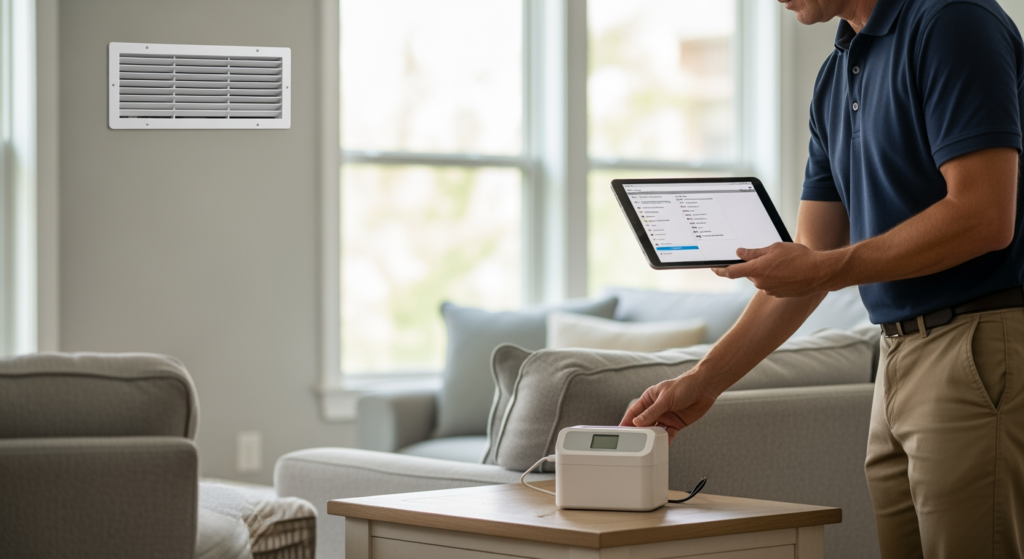
Choosing between mold testing and air quality testing can feel like trying to pick the right tool in a toolbox—both are useful, but they’re built for different jobs. If you’re a homebuyer, homeowner, or property manager in Athens, GA, the right choice can help you prioritize next steps, communicate clearly with contractors, and avoid paying for a test that doesn’t match your concern. Spring is also a common time for people to notice new odors, humidity changes, or allergy-like symptoms indoors, which often triggers questions about what to test for first. The key is to start with what you’re trying to learn: are you investigating a suspected mold problem, or are you evaluating broader indoor air conditions? Below is a practical, side-by-side comparison to help you decide.
To compare these options clearly, we’ll use a few simple criteria: what each test is designed to detect, when it’s most useful, what you typically receive in the results, and how to think about cost versus value.
If you’re looking for air quality testing in Athens, GA, it helps to understand how it differs from mold-focused sampling so you can request the right service for your situation.
Mold vs Indoor Air Testing
- Mold testing is best when you suspect mold growth, water intrusion, or need evidence to guide remediation decisions.
- Indoor air testing is broader and can help evaluate multiple airborne concerns, depending on what’s included in the scope.
- If you have visible growth or a known leak, mold-focused testing (plus moisture investigation) is often the more direct starting point.
- If your concern is general odors, comfort, or “something feels off”, a broader air assessment may be more informative.
- Neither option is a “pass/fail” stamp—results are typically interpreted alongside the building’s conditions and history.
- When in doubt, ask what the test can and cannot conclude before scheduling.
How Mold Testing and Air Quality Testing Differ
Mold testing generally focuses on identifying and/or quantifying mold spores (and sometimes specific types) from air samples, surface samples, or both. It’s most helpful when there’s a reason to believe mold may be present—such as past leaks, staining, musty odors, or visible growth.
Air quality testing is a broader umbrella term. Depending on the provider and the scope you choose, it may include sampling or measurements related to airborne particulates, humidity, ventilation indicators, or other contaminants. Because “air quality” can mean different things to different people, the most important step is confirming what the testing package actually measures and what the report will help you decide.
Side-by-Side Comparison: Which Test Fits Your Situation?
| Comparison Criteria | Mold Testing | Air Quality Testing |
|---|---|---|
| Best for | Suspected mold growth, musty odor tied to moisture, post-leak concerns, documentation before/after remediation | General indoor air concerns, comfort complaints, odor investigation when cause is unclear, establishing a baseline |
| What it targets | Mold spores and/or suspected growth areas (air and/or surfaces) | Varies by scope; may cover multiple indoor air indicators beyond mold |
| What results help you do | Support remediation decisions, locate likely problem areas, confirm whether further evaluation is warranted | Decide whether ventilation, filtration, humidity control, cleaning, or targeted follow-up testing makes sense |
| Limitations to know | Sampling is time-specific; results can be influenced by airflow, recent cleaning, and occupancy patterns | “Air quality” is broad; if the scope is vague, results may not answer your specific question |
| Common add-ons | Moisture mapping, thermal imaging, targeted sampling in suspect rooms | Humidity/ventilation review, targeted sampling based on symptoms or odors |
| Value mindset | High value when there’s a moisture story and you need mold-specific clarity | High value when the concern is broad and you need a clearer direction for next steps |
The Real-World Stakes: Cost, Comfort, and Decision Clarity
The biggest “cost” is often not the test itself—it’s paying for the wrong test and still not having a clear plan. Mold concerns may lead to remediation quotes, demolition decisions, or tenant communication, so clarity matters. On the flip side, broad indoor air concerns can turn into a frustrating loop of air fresheners, filters, and guesswork if you don’t identify the most likely drivers (like moisture, ventilation, or particulates).
Timing also matters. If you’re in a real estate due diligence window or planning renovations, the right testing approach can help you prioritize what to address first and what can wait for a specialist.
Common Missteps That Skew Results
- Assuming “air testing” automatically includes mold. Always confirm what’s being measured and reported.
- Skipping the moisture conversation. If there’s a leak history, humidity issue, or staining, moisture context is critical.
- Testing without a question. “Test everything” sounds nice, but it can produce data without direction.
- Ignoring building conditions on test day. Open windows, running fans, or recent cleaning can change what’s captured.
- Treating results as a diagnosis. Testing is typically one input; interpretation should consider the home’s layout, HVAC operation, and visible conditions.
- Not planning for next steps. Ask in advance what decisions the results are meant to support (repair, remediation, further evaluation, or monitoring).
A Smart Selection Plan
- Start with your trigger. Visible growth/leak history → lean mold-focused; general odor/comfort → consider broader indoor air evaluation.
- List symptoms and locations. Note which rooms, what time of day, and what conditions (rainy days, HVAC running, etc.).
- Document moisture clues. Stains, bubbling paint, warped trim, damp crawlspace odors—write them down before the visit.
- Ask what the report will include. Confirm the format, what’s measured, and how findings are explained in plain language.
- Clarify how sampling locations are chosen. Good plans are targeted, not random.
- Decide what “useful” means for you. A buyer may need negotiating documentation; an owner may need a repair roadmap.
Your Questions, Answered About Testing Options
Is mold sampling the same thing as an indoor air test?
No. Mold-focused sampling typically targets mold spores and/or suspected growth areas. Indoor air evaluation can be broader, so it’s important to confirm what’s included in the scope.
Which option makes more sense if I notice a musty smell?
A musty odor is often associated with moisture conditions, so mold-focused evaluation may be a logical starting point—especially if there are stains, past leaks, or damp areas. If the odor is vague or intermittent, a broader approach may help narrow the likely drivers.
Can testing prove a home is “safe”?
Testing results are typically a snapshot of conditions at the time of sampling and should be interpreted alongside the home’s visible conditions and history. It’s best to view results as decision-support information rather than a guarantee.
Do I need testing if I can already see suspected growth?
Not always. In some situations, the priority is identifying and correcting the moisture source and determining the appropriate next step for cleanup or remediation. Testing can be helpful when you need documentation, clearer scope, or confirmation for follow-up decisions.
What should I do before the appointment to get more useful results?
Write down where and when you notice the issue, note any leak or repair history, and avoid unusual activities that could change indoor conditions (like heavy cleaning right before the visit). Your provider can also tell you any specific prep steps for the chosen test.
Call BluePrint Home Inspection for Mold Testing in Athens
Mold testing and broader indoor air evaluation solve different problems, and the best choice depends on the question you’re trying to answer. If moisture or visible growth is part of the story, mold-focused sampling and investigation can be the more direct path. If the concern is general comfort, odors, or uncertainty about what’s in the air, a broader approach may provide better direction. Either way, clarity on scope and next steps is what makes the testing worth it.
Blueprint Home Inspection is proud to serve residents of Athens, GA and surrounding cities. With over 30 years of combined experience in home inspection, construction, and real estate industries, our company provides superior customer service and unique customized reports for all of our clients. Licensed and insured, we are one of the best inspection companies for the Greater Athens area and beyond. Our priority is to conduct a thorough home inspection so you can buy and sell your home with peace of mind.